Adapted from the 2002 film of the same name, written by Josefina López and George LaVoo, the new play is more resonant than ever in our current political and social climate.
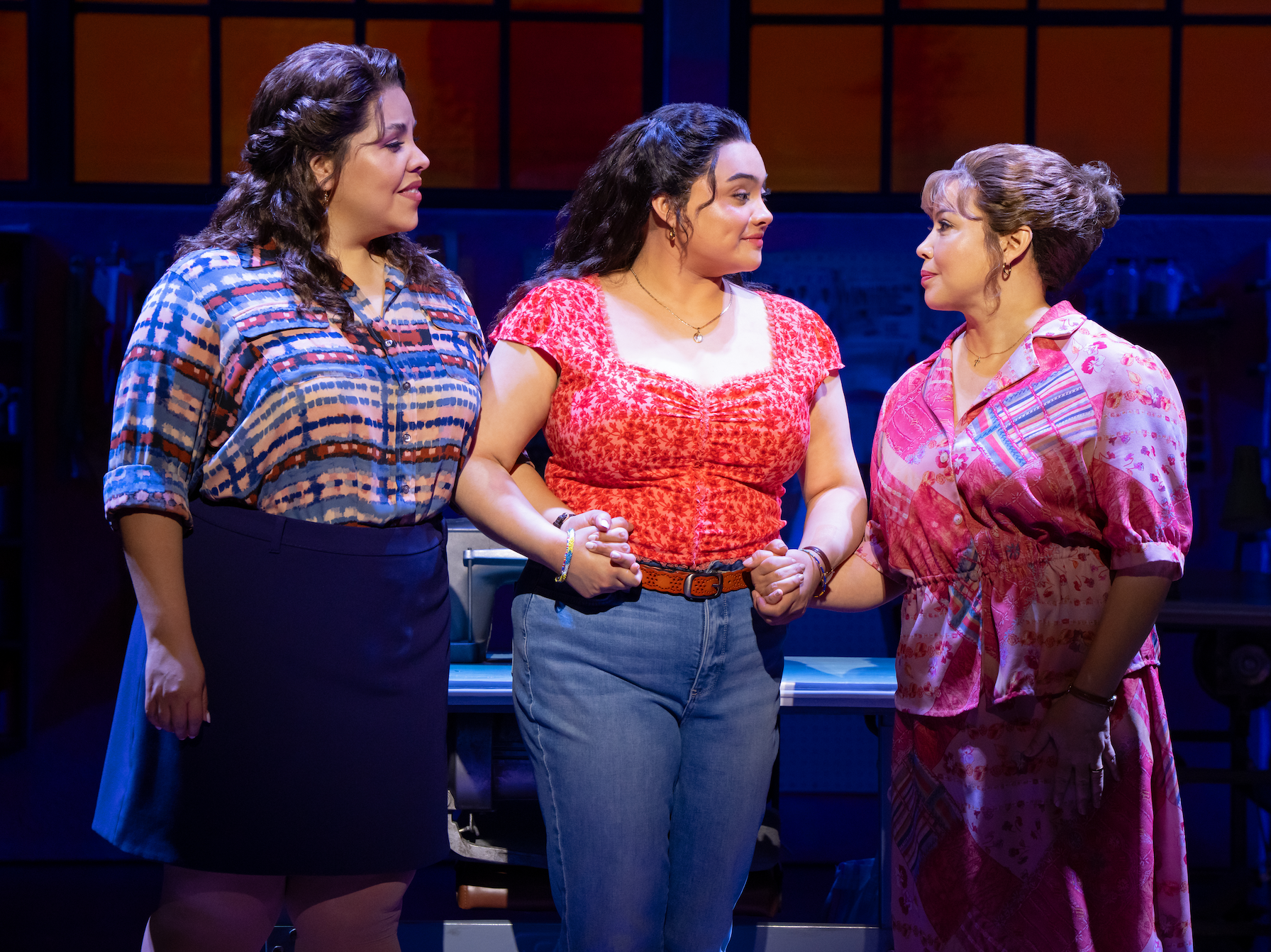
From L to R: Florencia Cuenca (Estela), Tatiana Córdoba (Ana) and Justina Machado (Carmen) in ‘Real Women Have Curves.’ Photo: Julieta Cervantes
Real Women Have Curves follows the García family, living in Boyle Heights, a predominantly Chicano/Mexicano neighborhood in East LA, set in 1987. Ana García (Tatiana Córdoba, making her Broadway debut!), the main protagonist, has been accepted to Columbia University’s journalism program. Cause for celebration, right? Not for everyone. Ana’s parents are unaware, and her sister Estela doesn’t share her enthusiasm for her Ivy League journey.
Ana is the sole U.S. citizen in her family who handles taxes and any other governmental logistics. Her older sister Estela owns a textile shop, barely making ends meet, and Ana’s mother, Carmen, wants Ana to work at the factory. Once Estela accepts an order for 200 dresses with a tight deadline and loses a worker to deportation, Ana steps in to help. She isn’t a seamstress; she has a few mishaps but gets the hang of it while her mother, Carmen, chastises her. Makes derogatory comments about her weight. Reminds her of her unrealistic ambitions, lack of sacrifice, and unwillingness to follow traditional female roles.
Even though the musical touches on universal complex topics of family obligations, guilt, and pursuing dreams, at the core is the love these women have for each other. A true sisterhood. Communicating their joy, frustration, and camaraderie through feet-stomping, electrifying songs like “Make it Work” and “Oye Muchacha,” and the poignant “If I Were a Bird,” sung by Ana and Itzel (Aline Mayagoitia, Broadway debut).
From L to R: Tatiana Córdoba as Ana and Aline Mayagoitia as Itzel in Real Women Have Curves; Photo: Julieta Cervantes.
Tatiana Córdoba is sensational as Ana García, hitting all the right notes and convincingly conveying emotions — from defiance, sadness, to jubilation. Poised for continued success on the Great White Way, the young performer graces the stage like a seasoned pro. Florencia Cuenca (Estela, also making her Broadway debut) is the first Mexican immigrant to star as a co-lead, dominating the role as the goading older sister yet empathetic best friend and champion of Ana’s dreams. Veteran stage and television actress Justina Machado (In the Heights, A Free Man of Color) joins the cast as Carmen, the overbearing mother, a multi-layered character who warrants both compassion and reproach. Machado’s acting is fantastic, making Carmen likable and relatable. Last, but not least, is the patriarch of the family, Raúl (Mauricio Mendoza, Resurrection Blvd, Matlock), a calming force amid a sea of estrogen. Seasoned actor Mauricio Mendoza is up to the task, serving as the voice of reason to his family’s boisterous, resolute women with captivating charm.
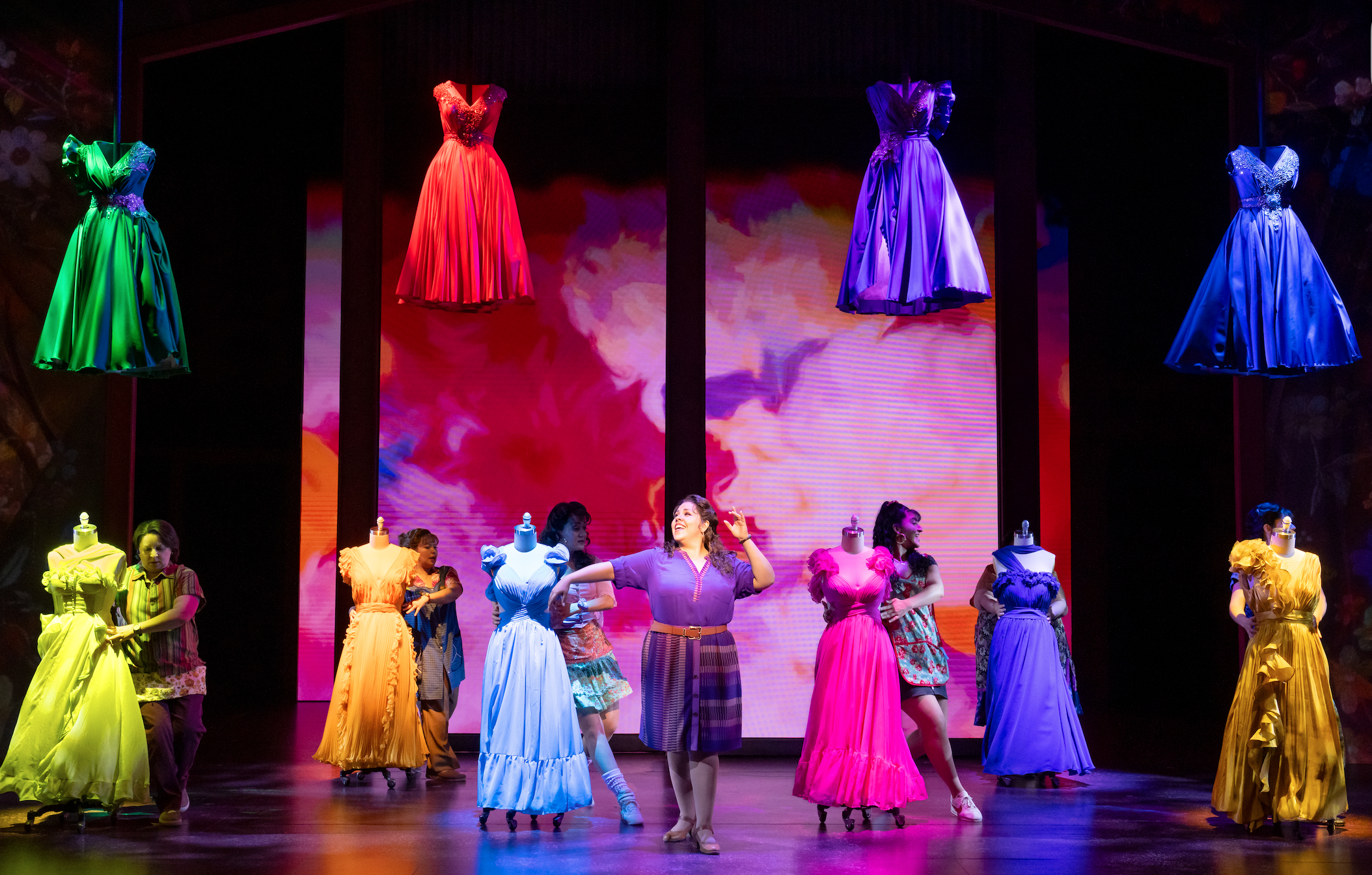
Florencia Cuenca (Estela) and ensemble in ‘Real Women Have Curves.’ Photo: Julieta Cervantes.
The set design (Arnulfo Maldonado, Buena Vista Social Club) and costumes are rich in warm, Latin American cultural hues, featuring stunning, vibrant dresses that embody the spirit of Mexican Americans.
Real Women Have Curves, the musical, directed and choreographed by Sergio Trujillo (first-ever Latino to receive the Tony for Best Choreography, Ain’t Too Proud to Beg: The Life and Times of the Temptations), written by Lisa Loomer (The Waiting Room) and Nell Benjamin (Mean Girls) and music and lyrics by Joy Huerta (Broadway debut and first Mexican-American woman to compose a musical), and Benjamin Velez (Broadway debut) is playing at the James Earl Theatre. Don’t miss this spectacular musical. Click here for tickets!
Secret operative missions, stand-up comedy, and a who-dun-it; Netflix enthralls viewers with a new batch of titillating entertainment.
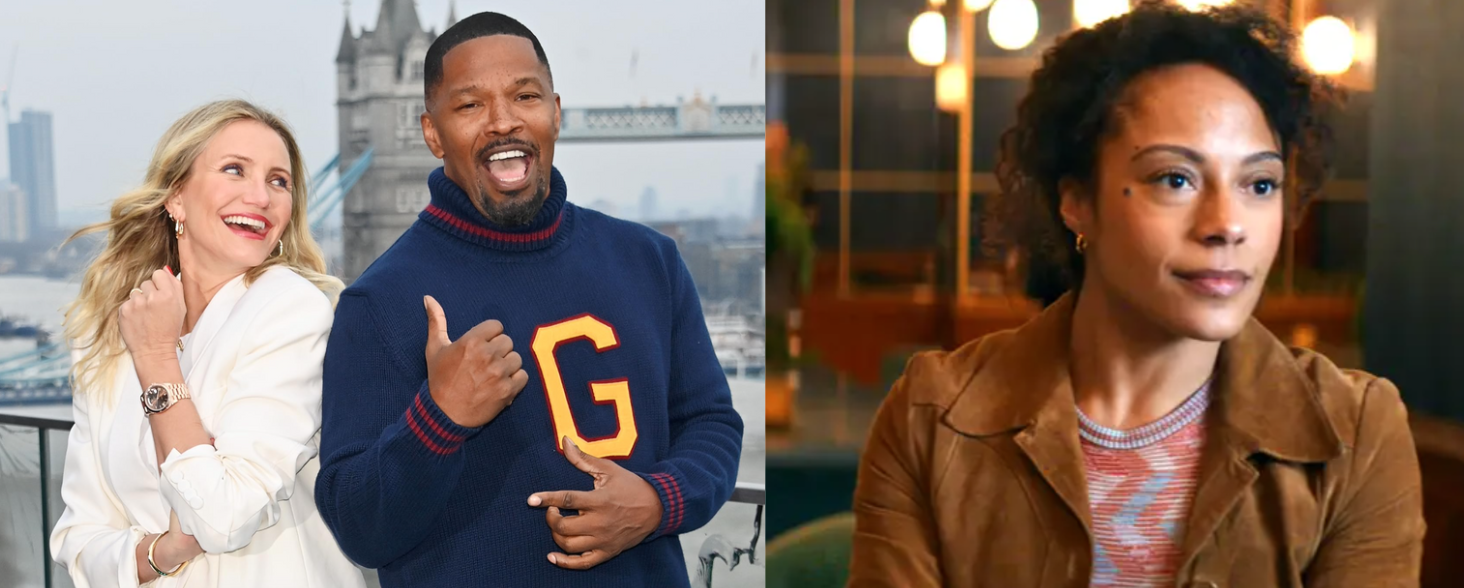
From L to R: Cameron Diaz, Jamie Foxx, and Rosalind Eleazar; Photo Credit: Netflix.
Superstars Cameron Diaz (Emily) and Jamie Foxx (Matt) make a splashy comeback with their spy thriller Back in Action. The couple plays a pair of brilliant CIA spies in a clandestine relationship. Once Diaz finds out she’s pregnant with their child, they decide to disappear, assume new identities, marry, and move to the suburbs until their cover is blown. Forced to return to the world of espionage with precocious teens in tow, they battle oligarchs and their henchmen until their family is safe. Glenn Close (Fatal Attraction, The Wife) plays Cameron Diaz’s estranged mother, whose actions allude to being a former spy, and she’s glorious as usual! An actor’s actor.
Both actors are in great shape, and we buy their roles as GenX martial experts who haven’t lost their edge. Back in Action marks Diaz and Foxx’s return to cinema. Diaz hasn’t starred in films since 2014, and in the middle of shooting the action-comedy, Foxx had a medical emergency that left him out of the spotlight for a few years. The two stars have dynamic chemistry and a natural comedic ability. Cameron Diaz’s Emily is reminiscent of Natalie Cook’s graceful fight scenes from the Charlie’s Angel franchise (2000–2003), while Foxx channels his Django character’s stealth moves.
Cameron Diaz and Jamie Foxx proved their bankable stars as Back in Action remains the top film on Netflix.
Cameron Diaz and Jamie Foxx in ‘Back in Action’; Photo Credit: Netflix.
Clearing the air and setting the record straight on his hiatus from TV and Film, Foxx stars in his poignant and hilarious comedy special What Had Happened Was. Rumors and conspiracies stating that P. Diddy drugged Foxx to him becoming a paraplegic were debunked by Foxx. The truth, as confirmed by the actor, is that he had a brain bleed, leading to a stroke that doctors had a hard time diagnosing, and his sister stepped in to advocate for further analysis. Foxx addresses the severity of his condition and epiphanies, makes jokes, and sings in this hilarious and poignant one-hour show. Foxx still got it, but more importantly, never lost it.
Lastly, Harlan Coben returns with his book adaptation series, Missing You. And use John Waite’s hit 80s song “Missing You” as the musical backdrop.
Rosalind Eleazar (Kat) and Richard Armitage (Stagger) in ‘Missing You’; Photo Credit: Netflix.
Missing You follows Kat Donovan (Rosalind Eleazar, Slow Horses, Deep Water), a detective inspector in the U.K. whose fiance broke off their engagement and went off the grid for 11 years. To make matters worse, Kat learns her father’s murderer is about to die and visits him to find out why he murdered him, a former policeman. In true Harlan Corben fashion, there are more winding twists and turns than the steepest stairwell in a centuries-old European castle in this story. And fans of the suspense-thriller author will love it! Not to mention the diverse multinational cast and Coben favorite and veteran British actor Richard Armitage (Fool Me Once, The Stranger) as Donovan’s boss, Ellis Stagger.
Fluff up your couch and prepare your favorite snacks for a superb TV viewing this weekend or next. Back in Action, directed by Seth Gordon (Horrible Bosses, Identity Thief). It’s Netflix’s highest-grossing film to date. Jamie Foxx’s honest Golden Globe-nominated special What Had HappenedWas, detailing his recovery, is ripe with impersonations, storytelling, and singing extravaganza. If you’re looking for more than a contained show or film, check out the 5-episode limited suspenseful series Missing You.
But Emmy honors for Latinas didn’t stop with the Puerto Rican actress. Selena Gomez and showrunner Issa López also broke entertainment barriers.
Liza Colón-Zayas with her Emmy for Best Supporting Actress for “The Bear.” Photo: courtesy of 76th Annual Emmys.
One of the night’s biggest surprises at the Emmys this year came when actress Liza Colón-Zayas secured the win for Best Supporting Actress in a Comedy Series for “The Bear.” Colón-Zayas plays the outspoken and talented sous chef, Tina Marrero, who relishes standing up for herself and the rest of the kitchen staff in the hit series “The Bear,” now in its 3rd season. If you’re unfamiliar with “The Bear,” it’s about a professionally-trained chef, Carmy (Jeremy Allen White, winning Best Actor in a Comedy Series this year), who comes back to revitalize his family’s restaurant after his brother passed away. Conflict arises when Carmy brings in new staff and attempts to work with the existing staff, often resulting in explosive situations that both invigorate and debilitate Carmy’s mental state.
Liza Colón-Zayas’ character (Tina) often bumps heads with Carmy. But she does so endearingly and authentically, and that’s why she was victorious against her equally talented nominees as she gushed about on the Emmy stage, who share the category: the incomparable Meryl Streep (“Only Murders in the Building”), Carole Burnett (“Palm Royale,”), Janelle James and Sheryl Lee Ralph (“Abbott Elementary”), and Hannah Einbinder (“Hacks”).
Liza Colón-Zayas in her one-woman show ‘Sistah Supreme.’ Photo courtesy of Playbill.
Emmy-winning Colón-Zayas began her entertainment career by writing, starring, and producing her one-woman off-Broadway show Sistah Supreme in 2000. She segued to television and had supporting roles in shows like “In Treatment” and Law & Order: SVU,” Her portrayal of Tina Marrero is Liza Colon-Zaya’s first Emmy Award nomination and win. With her humbled appreciation for the Emmy acknowledgment and tears of joy, she ended her speech with these parting words:
“To all the Latinas looking at me, keep believing and vote. Vote for your rights!”
Her sound advice couldn’t be more timely as far-Right extremists are looking to roll back reproductive freedoms, institute archaic education policies, and dismantle union worker protections.
*Did you know today is National Voter Registration Day? You can check if you’re registered to vote here.
Sidenote:
Other Latinas who made their mark at the 76th Annual Emmy Awards are Selena Gomez and showrunner Issa López. Gomez is the most Emmy-nominated Latina to date with a third production nomination for the mystery-comedy series “Only Murders in the Building,” receiving her first lead comedy actress nomination this year, becoming only the fourth Latina in history nominated in this category. Moving to the executive producer category, showrunner Issa López garnered three Emmy nominations for directing, writing, and producing the HBO/Max anthology series “True Detective: Night Country.”
While this year’s Emmys included more diversity (the number of people of color nominated increased to 30 of the 96 acting nominees), here’s hoping recognition of creative diversity in all Hollywood award shows will accelerate in coming years.
Richly described, flawed characters who, despite their imperfections, come together to serve a bigger purpose than themselves.
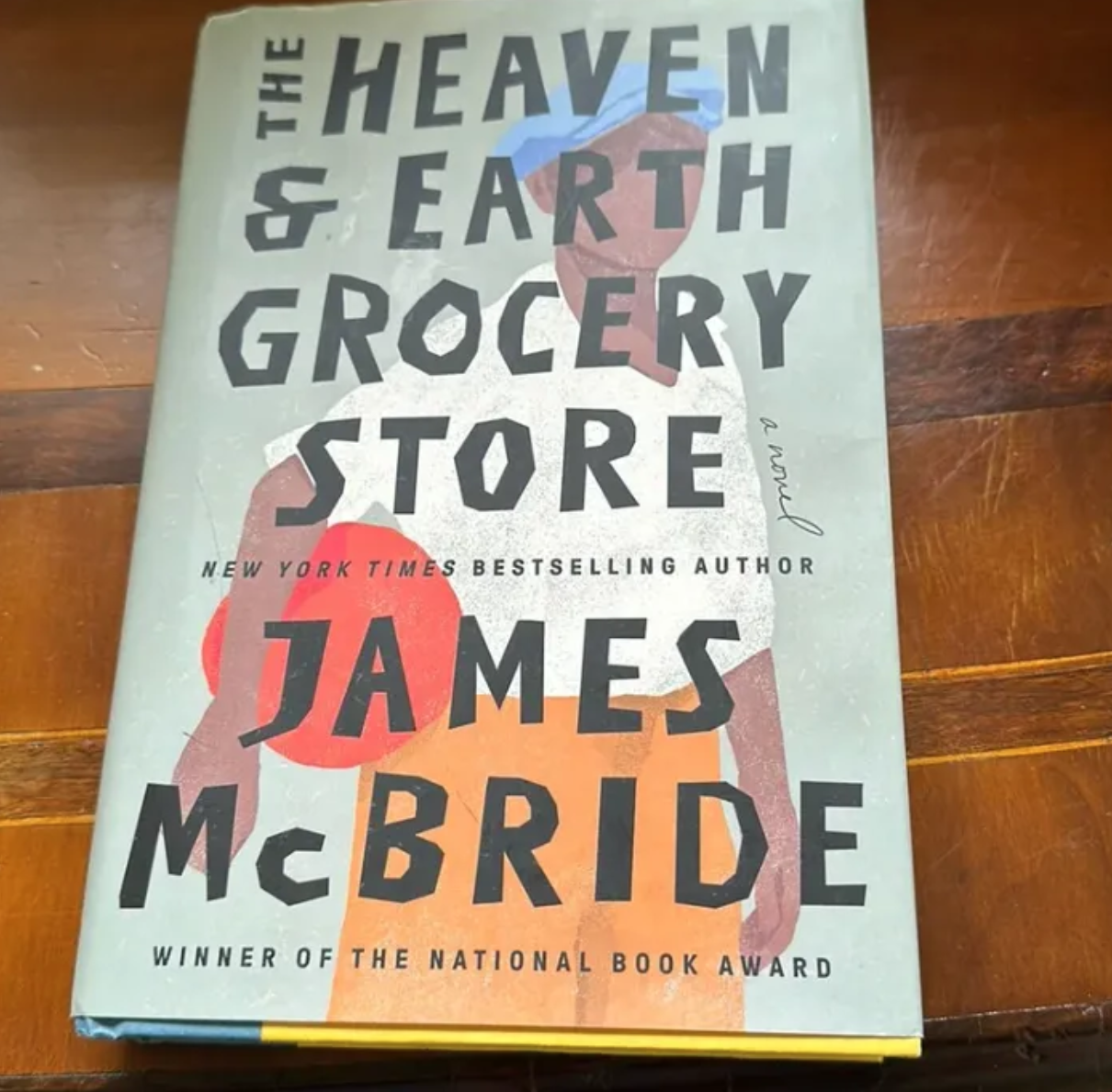
The Heaven & Earth Grocery Store Hardcover book by James McBride; photo: Mercedes Vizcaino
James McBride’s The Heaven & Earth Grocery Store is my first book review on Medium. I felt compelled to write about it because I was still thinking about the novel weeks later, even though I’d started another book. We know books are highly subjective because they tend to follow genres that readers gravitate toward or not. This particular novel weaves multiple genres, and the storytelling is so masterful you barely notice if it’s fiction, horror, or memoir — or all three! I bought the book earlier this year because I was intrigued by it. At the end of last year, I saw two editors on TV from two platforms (Amazon Editors and Barnes & Noble) gush about the story, the writing, and how the characters made them feel afterward, declaring it the best book of 2023.
They were right.
Anyone who asks who I’m currently reading or not, I recommend The Heaven & Earth Grocery Store novel.
So what’s the story about?
The book begins with the discovery of a skeleton with a Jewish mezuzah (a symbol that connects, protects, and unites Jews) in a well excavated by construction workers in Pottstown, PA, in the 1970s and flashbacks to 1936. The author tells the story of the residents of Chicken Hill, made up of African-Americans, Jews, and Christians, who are at odds with each other but find a way to coexist.
The owner of The Heaven & Earth Grocery store is Chona, a Jewish woman married to Moshe, a Jewish-Romanian theater owner who brought artists of all different creeds and religions to his performing arts space. Moshe and Chona Ludlow, although very religious, are accepting of the African-Americans in Chicken Hill, whereas other whites are not. Chona, a disabled woman with striking features and a heart to match, provides unlimited credit to the Black residents of Chicken Hill, often overlooking collecting the debt. She doesn’t subscribe to tenets of Christian nationalism, which many of the other white residents of Chicken Hill are susceptible to. As the white people in Chicken Hill prosper, including their Jewish friends, they move out to more affluent areas, leaving Moshe and Chona as the Jewish outliers who aren’t interested in wealth mobility or status.
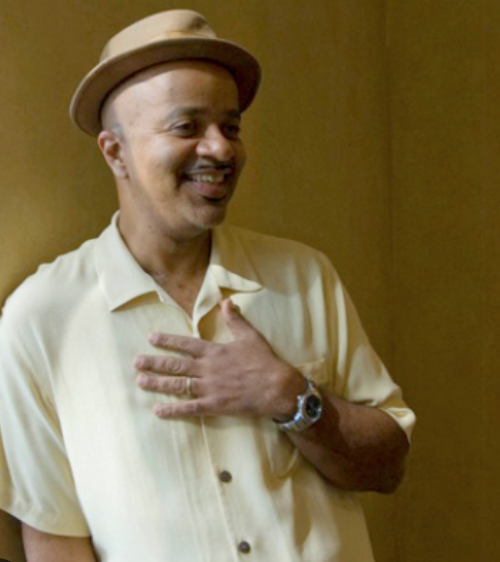
Author and musician James McBride; photo courtesy of Riverhead Books. When Moshe’s Black theater worker and best friend, Nate Timblin’s 10-year-old deaf nephew, Dodo, becomes the target of state investigation to send him to a state hospital for people with disabilities and mental illness (which the child does not have), Chona intervenes. She does everything within her power to keep the child safe, to her detriment. I won’t go on so as not to reveal too much so you can bask in McBride’s captivating storytelling. Not since Joan Didion’s The Year of Magical Thinking (dealing with the subject of grief) has a book left such a lasting impression on me. The themes of community and helping each other out no matter what background, religion, or walk of life people come from are prevalent and speak to a world we can aspire to live in one day.
Read this book, STAT! Digitally, audibly, or buy the hardcover.
By intertwining technology, sustainable fabrics, and customizable silhouettes, Lauer has given the one-piece garment a much-needed makeover that rivals contemporary luxe brands.
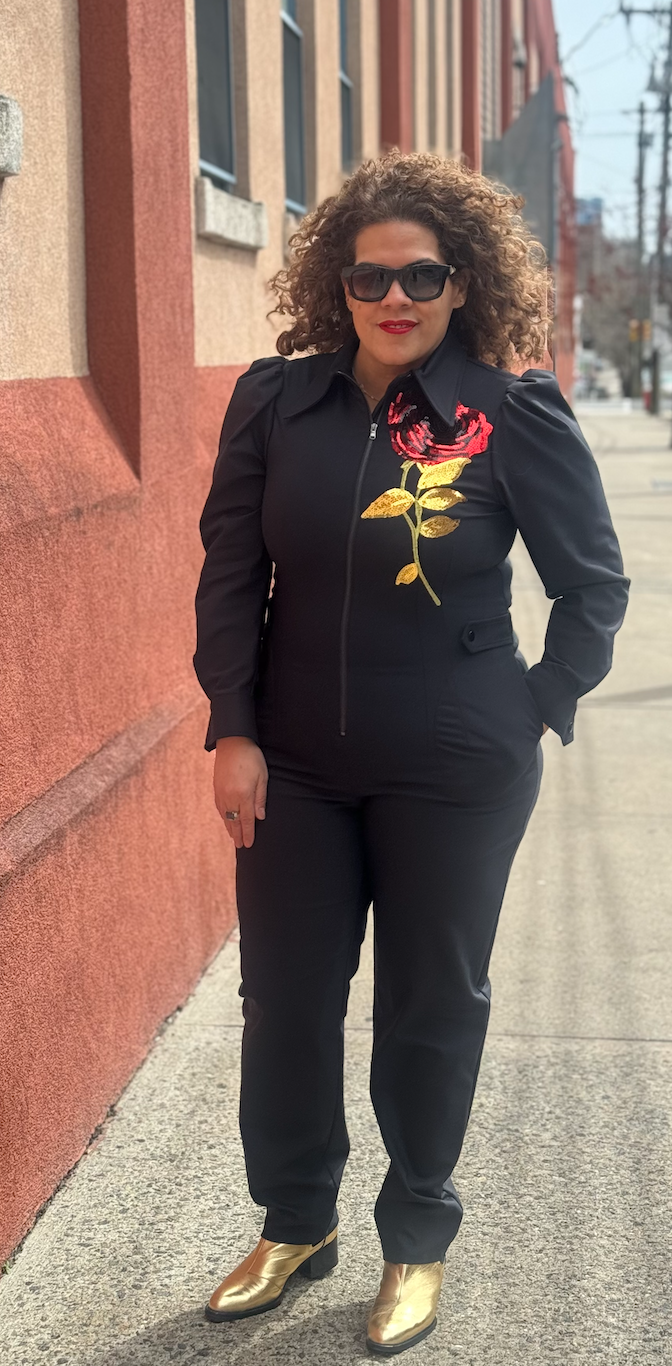
Fashion designer Andrea Lauer at her Risen Division shop in Red Hook, Brooklyn; photo; Risen Division website.
The award-winning artist, scenic, and costume designer is no stranger to creating statement fashion pieces. Andrea Lauer has outfitted musicians and Broadway, TV, and film stars for years, taking their wardrobes to new heights. From Billy Joe Armstrong to Melissa Etheridge, now she’s more than ready to adorn the rest of us with her stylish jumpsuits.
I love fashion. Always have. As a kid, my older cousins would parade their fabulous eighties shimmery threads at family functions. They had the build for all types of clothing. I didn’t. I was short and plump and wore what was flattering and unexciting. One recurring fashion memory in my childlike mind involved an iridescent gold lamé jumpsuit with accentuating attributes my cousin once wore. She resembled a golden goddess ready to climb into her Formula One racing car with the same hue as her outfit. At a book signing in NYC’s Gotham restaurant, I came across someone wearing a jumpsuit reminiscent of this sparkly one-piece designed by Andrea Lauer.
Lauer had models of varying body types and ages wearing her whimsical fitted jumpsuits. What struck me the most was that each piece looked completely different on each model, as if the garment was an extension of their personalities. There was a sea of jumpsuits in black seersucker, navy with white pinstripes, metallic, a rich, satiny blue that reminded me of a beach in Cote d’Azure worn by a sixty-something model that slayed the look. Think Debbie Harry meets the lead singer of The Runaways, Cherie Currie. I was mesmerized.
I chatted with Andrea Lauer, Founder and Creative Director of Risen Divison, a fashion brand specializing in the cult and art of the jumpsuit. She shared her insights into sparking a renaissance of the one-piece garment.
M. Vizcaino: What was the impetus to create a fashion line centered solely on one garment?
A. Lauer: My background is in clothing and costume design, working in theatre and film, television, and music. A few years ago, I decided to launch Risen Division and open a store that doubles as my atelier and studio for all my other projects. I’ve always been curious about the history of the jumpsuit, not just in fashion but also in its connotations in our culture. Studying costume history, I discovered the inventor of the one-piece garment was Ernesto Michachelles, an Italian futurist who went by the pseudonym of Thayaht. He wanted to make a utilitarian garment available to the public and printed the design in the newspaper for anyone to make. After learning this, it sparked an interest in the garment, as an artist looking at what clothing can tell you about a moment in time. From there, I started looking at space and space travel. In space, you need to wear a one-piece garment. In other cultural carriers of this idea of uniform in our society, predominantly used for incarceration, mechanics, and workers in varying industries — historically, the jumpsuit is representative of the uniform of the masses. I wanted to take this concept of the uniform and the masses, flip it on its head, create a garment that was an elevation of the individual, and adjust the perception of the jumpsuit — how to step into it. And that’s when Risen Division was born.
Fashion designer Andrea Lauer making adjustments to her Risen Division jumpsuit; photo Craig La Court.
M. Vizcaino: What’s the meaning behind the brand name?
AL: Garments used for the division of labor. That’s where the division comes from. But then I considered taking it to a higher power if you raise something to the square power in mathematics, like R-squared. The idea of dividing labor, bringing it to the masses with a different version of workwear encompassing couture, in how it’s made, and raising the individual aesthetic through the garment. The concept for the brand also materialized from people in history. I love literature and am inspired by people who have had an unusual path, broken barriers, and impacted culture.
MV: Which figure in history did you choose for your first design?
AL: My muse for my first jumpsuit is Virginia Woolf. I named it the Woolf piece. Although she disliked fashion, she moved through life by her own rules, not letting societal conventions dictate her existence. Another inspiration for one of my signature jumpsuits is the Quimby, an homage to Harriet Quimby. She was the first female aviator (not Amelia Earhart) to acquire a pilot’s license and travel across the Atlantic on a plane in a violet flight suit — and the original Quimby is a plum metallic jumpsuit. My pieces reflect the contributions these fascinating outliers made to society. It’s important for me to imbue their stories through design and capture the details.
MV: You mention sourcing sustainable materials to make your garments on your site. Can you walk me through the process of creating your jumpsuits?
There are two ways I think about jumpsuits: style and material. I’ve created seven different styles. Each of the styles is based on a person from history. I created a specific collection based on a movement, not a person, called the Bauhaus Collection. I wanted this collection to be accessible to every human, not just one person; it’s unisex and for every gender. What does the material tell us, the fabric and the weave? It has to tell a story. I’m inspired by seersucker, the traditional fabric for the gentleman’s suit of the South. I found a Japanese company, a mill, that makes sustainably produced seersucker using low water consumption and organic cotton with high twists, a strong material with high longevity. That means that it can withstand washes and is stain-repellant, an elegant and functional material. I interchange materials based on seasons and what’s available. I was thinking about scarcity wisely. Just because we have small amounts of something doesn’t mean we can’t use it. Scarcity challenges my design sensibility and forces me to think outside the box of mass production and design something special. I’m sustainable by nature, and it echoes in everything I do. People can come to the shop in Brooklyn and try on ten different jumpsuits with one-of-a-kind embroidery, sequins, or vegan leather (materials that can’t be reproduced) and leave with an incredible piece. Customizable jumpsuits that aren’t available on the website.
M. Vizcaino: What are your plans for Risen Division? How do you see the brand evolving?
A. Lauer: Risen Division focuses on enhancing the jumpsuit’s beauty in its one-and-done practicality. You can style it up or down by adding something and transforming it from day to night. I’m a fan of all jumpsuits. I even had a jumpsuit party, encouraging guests to wear their favorite designs. I’d love to collaborate with other brands. My dream is to reimagine the flight attendant’s uniform and create a jumpsuit that embodies the service they provide, transcending their individuality.
Andrea Lauer’s creative work in scenic and fashion design and her innate understanding of materials share a common theme of design and body composition. Her curiosity about the human form has led her to create designs with AI and solve design challenges, pushing the boundaries of the one-piece garment while maintaining a sustainable business model.
According to Lauer, “Technology can aid human design but not replace it.”
Andrea Lauer is a maker at heart. She believes the Risen Division is a meditation on the body, with the one-piece garment as the vessel. This reflects the brand’s mantra: “In jumpsuits, we trust.”
Click here to shop Risen Division’s spectacular, versatile, sustainably made jumpsuits. You can also visit her Brooklyn storefront for a custom-made piece.
Giamatti, the two-time Oscar nominee, conjures up all the feels from audiences in the film. Disdain. Sympathy. Anger. Revulsion. Laughter.
Paul Giamatti as Paul Hunham in ‘The Holdovers’; photo courtesy of Focus Features.
There hasn’t been one Paul Giamatti film that has left me disappointed. And the latest Alexander Payne-directed film is no exception. It’s Paul Giamatti at his best. His brand of know-it-all, feigning righteousness, flawed, non-handsome yet alluring, often funny characters that make terrible decisions but somehow come out on top is on full display. In The Holdovers, it comes in the form of Paul Hunham, a New England classics prep school teacher who’s a misanthrope tasked with babysitting a group of students with no place to go during Christmas break in 1970. Punishment or payback from the school headmaster for Mr. Hunham not passing a legacy student from an influential and powerful family.
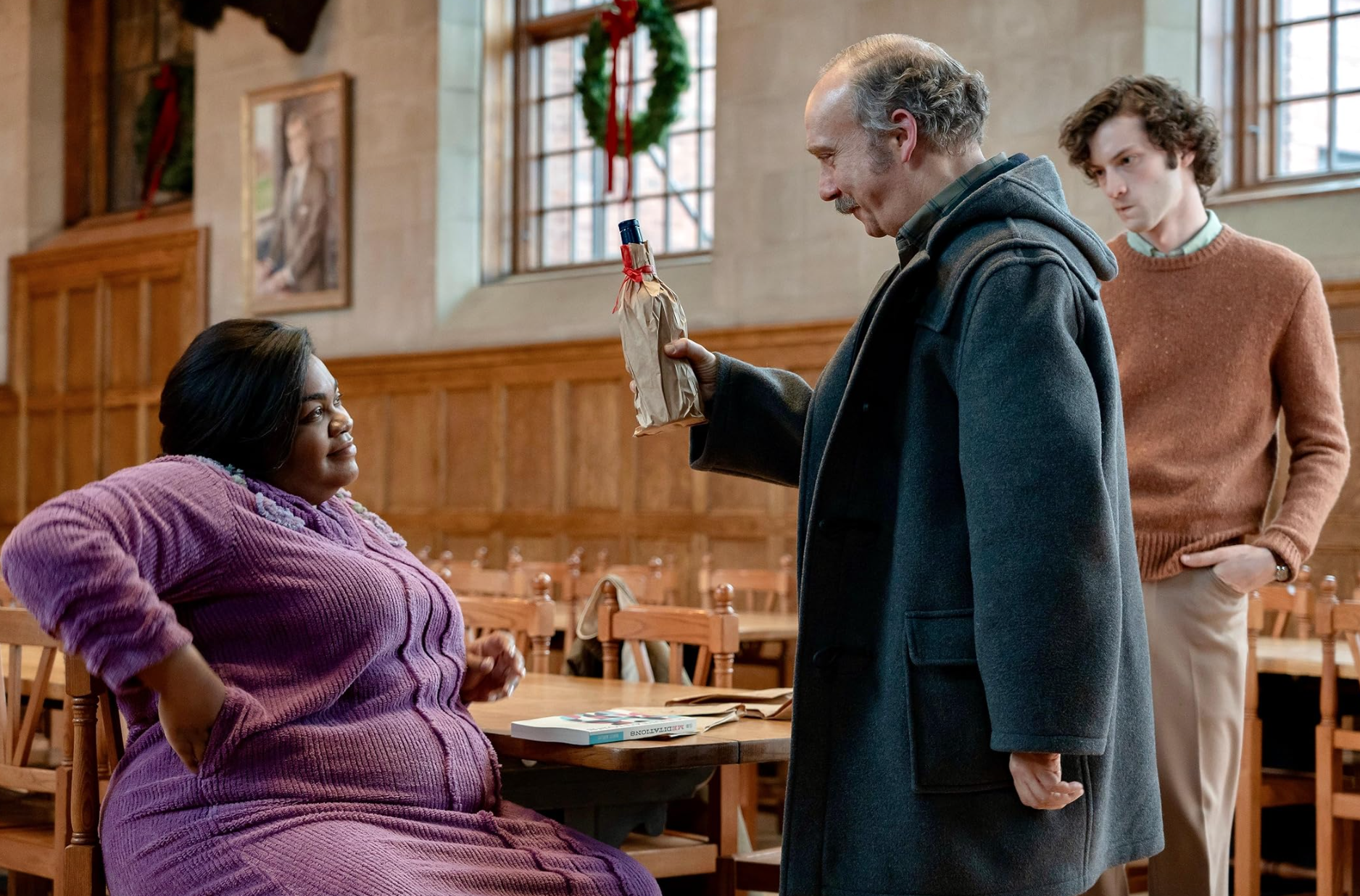
Da’Vine Joy Randolph as Mary Lamb, Paul Giamatti as Paul Hunham, and Dominic Sessa as Angus Tully in ‘The Holdovers’; photo courtesy of Focus Features.
When most of the group is rescued by a fellow student’s well-to-do parent, whisking them off to a family winter escapade via helicopter on school grounds, all but one student is left behind. Angus Tully, a smart and troubled 17-year-old, played by Dominic Sessa (debut role), can’t bear his fate and makes the situation unbearable for Mr. Hunham. Rounding out the crew of stragglers at the prep school is Mary Lamb, the head cook who serves as a buffer between teacher and student, played subdued and empathetically by Da’Vine Joy Randolph (Ghost on Broadway, Dolemite), who also received an Oscar nom for Best Supporting Actress in the film.
The Giamatti Effect
I first saw Paul Giamatti as Kenny “Pig Vomit” Rushton on the screen. A nickname unaffectionally bestowed by Howard Stern in his autobiographical 1997 film Private Parts. In the film, Giamatti’s character is the shock jock’s boss at WNBC radio station. He is as annoying as he is entertainingly comical, constantly harassing Stern to watch his language on air and to identify the station’s call letters with more pizzaz. Pig Vomit epitomizes nightmarish, quirky, micromanaging bosses, and Giamatti plays him to insolent perfection. A role believed by critics to upstage Howard Stern’s character in the film, with which I wholeheartedly agree. Giamatti’s “W-NNN-B-C” is one of the most memorable lines from the movie that catapulted his acting career.
Howard Stern as himself and Paul Giamatti as Kenny “Pig Vomit” Rushton in ‘Private Parts’; photo courtesy of Paramount Pictures.
Other Giamatti Gems
Alexander Payne and Paul Giamatti first collaborated on the critically acclaimed Sideways, where Giamatti plays a divorced middle-aged English professor (even though he was 36 at the time) and aspiring writer who takes a road trip through California’s wine country with his actor-best friend (Thomas Haden Church, Wings, Twisted Metal) right before his wedding. Both characters are loathsome as they are loveable and engage in absurd, funny situations. It’s the perfect pair of f@*k-ups you can’t get enough of.
Next up: The Illusionist, where Giamatti plays Inspector Uhl, a curiously skeptical officer and music lover during turn-of-the-century Vienna, who is on the heels of arresting Eisenhem (Edward Norton, Fight Club, American History X), a master magician with abilities to bring back people from the dead and hypnotize audiences while pining for his childhood love, Duchess Sophie (Jessica Biel, Candy, The Sinner), who is out of his economic class. Giamatti brings so much depth to the role and is delightfully enigmatic as the inspector. You can’t imagine any other actor in the role.
3 Fun Facts About Paul Giamatti:
Giamatti wore a prosthetic eye to emphasize The Holdovers’ Paul Hunham character’s lazy eye defect.
Giamatti went to Yale for theatre, and his father, Dr. Bart Giamatti, was president at the Ivy League college before becoming the 7th baseball commissioner for MLB.
Paul Giamatti, Edward Norton, and Ron Livingston went to Yale, studied theater together, and remained good friends.
In theatres, you can watch Paul Giamatti’s latest heartfelt dramedy, The Holdovers, written by David Hemingson (Whiskey Cavalier, Kitchen Confidential), or stream it on Amazon Prime.
How One Man’s Dream to Spice Up the Cheeto Came to Fruition.
Flamin’ Hot Movie Poster; Photo: 20th Century Studios.
As a kid traveling to Mexico, I was always intrigued when the locals would add Tajín spice (a unique blend of 100% natural chili peppers, lime & sea salt) to fruits and almost all of their cuisine. Spice is a staple for Mexicans. I’m Cuban, and we’re used to heavy seasoning, but not food that would set your mouth ablaze. Thefilm triggered memories of my almost choking on a mango with Tajín and thinking, ‘I might die, but this is delicious.’
Flamin’ Hot follows Richard Montañez (Jesse Garcia), a Mexican-American man’s corporate journey to revolutionize the popular American snack based on his book: A Boy, a Burrito, and a Cookie: From Janitor to Executive. Actress/producer/ director Eva Longoria made her feature directorial debut and brought Richard’s story to the big screen.
Richard Montañez (Jessie Garcia) and Judy Montañez (Annie Gonzalez); Photo: 20th Century Studios.
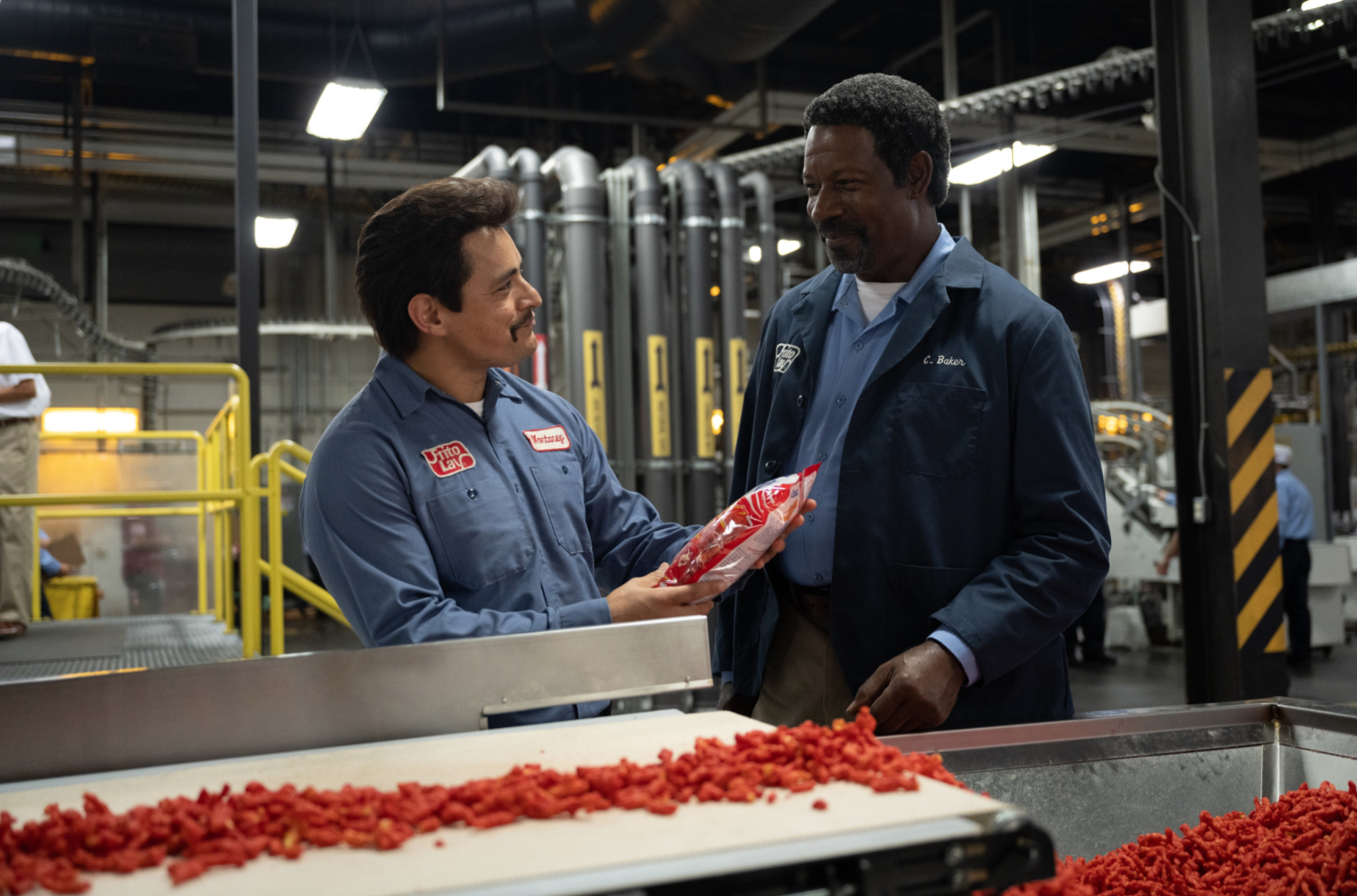
We meet Richard as a boy in 1960s Los Angeles in Guasti, California, a community of grape pickers struggling to make a living. Montañez has ten siblings. Life was hard, rife with racism and run-ins with the law. Making matters worse, he grew up with gangs and limited opportunities to make money legally. However, the one positive thing in his life was his childhood sweetheart, Judy (Annie Gonzalez), and partner-in-crime until she became pregnant. With his father’s derogatory comments about him in his head and unflinching determination, Richard decides to make a change. He seeks the help of a fellow gangbanger who left “the life” behind by working at the Frito Lay plant. Richard lands the janitor job and gravitates toward the most intelligent man on the plant floor, an engineer named Clarence Baker (Dennis Haysbert), who educates him on the ins and out of production.
Richard Montañez (Jessie Garcia) with Clarence Baker (Dennis Haybert); Photo: 20th Century Studios.
After hearing that Frito Lay sales are down and the plant might close, Montañez develops a spicy concoction with his family in their kitchen and create a new product that celebrates their Mexican heritage. The idea didn’t take off initially, as corporate naysayers didn’t invest in the product’s marketing and promotion. Undeterred, Richard finds another way to get consumers’ attention. His drive to succeed is unparalleled, and the film affirms this message.
Flamin’ Hot is an American immigrant story that relates, inspires, and speaks to American tenacity by proving people wrong and making it anyway! The story’s pacing is perfect, and the characters are lovable and funny.
Yet, the film is full of controversy. In 2021, after Richard Montañez’s book was released, a Los Angeles Times reporter published an article titled: “The man who didn’t invent Flamin’ Hot Cheetos,” claiming his year-long investigative reporting, along with Frtio Lay’s internal investigation concluded that Montañez’s dates are off as well as his association CEO, Roger Enrico (Tony Shalhoub), who in the movie greenlit Montañez’s game-changing idea.
Richard Montañez holding a Flamin’ Hot Cheetos bag; Photo: 20th Century Studios.
Following the article’s publication, Richard Montañez responded:
“I don’t care what room you’re in; somebody in the room will always try to steal your destiny. People may even say you never existed. I want you to do this: Write down your history because if you don’t, somebody else will. Remember that. And also, remember this, the best way to destroy a positive message is to destroy the messenger. Never allow that to happen to you. I’m certainly not going to let it happen to me.”
PepsiCo, Frito-Lay’s parent company, later stated:
“Far from being an urban legend, Richard had a remarkable 40-plus-year career at PepsiCo and made an incredible impact on our business and employees and continues to serve as an inspiration today. His insights and ideas on how to better serve Hispanic consumers were invaluable and directly resulted in the success of Flamin’ Hot Cheetos. To be clear, we have no reason to doubt the stories he shares about taking the initiative to create new product ideas for the Cheetos brand and pitching them to past PepsiCo leaders.”
Sure. Hollywood is known to embellish true stories to dramatize plots, but corporations are notorious for poaching ideas from employees without giving them their due credit. And why would Richard Montañez go on a limb if his version wasn’t authentic? You be the judge. Flamin’ Hot is streaming on Hulu and Disney+. Watch it now!
Photo: Courtesy of Janessa Rose Perez, Janessa Rose Perez in Coney Island
Although Latinas have been disproportionately affected the most by the economic fallout the pandemic has inflicted, accounting for 45% job loss in the U.S.; there is also good news: as of last October, new data reveals Latinas are more determined than ever to achieve entrepreneurial and financial success in the arts, entertainment, and cultural sectors. One such Latina making her mark in her community, driven to make to make an impact for generations to come is Janessa Rose Perez. The first-time author, CEO and founder of the non-profit Motivational Monsters, Inc. is taking a stand and giving voice to the under-served neighborhood that has shaped and transformed her into a pillar of strength and positivity.
We sat down with Janessa Rose to learn more about her decision to self-publish during the throes of the pandemic lockdown, her interest in community activism, and her motivation to pursue entrepreneurship.
When did you launch your nonprofit Motivational Monsters Inc.? Can you walk us through your journey in launching this organization and why you thought it was necessary?
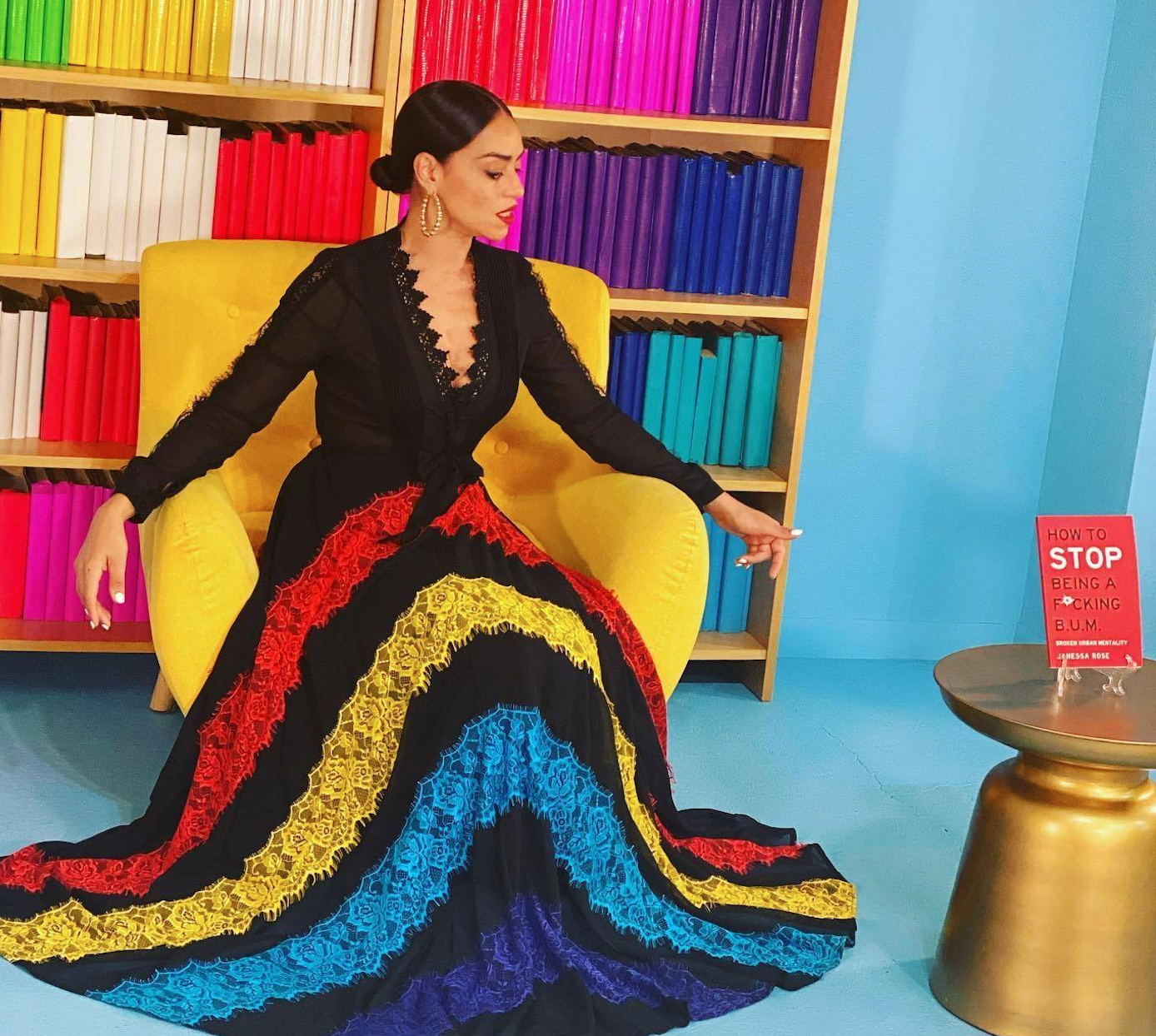
I started the nonprofit in 2018, after I had managed independent entertainers and artists. Working with them triggered something in me – songs about street-life, dealing with situations that I had experienced, growing up in Coney Island and confronting issues that caused me pain. I wanted to start a company and build programs around the community I’m from – addressing overcoming and healing trauma. Initially, I wanted to have a platform for motivational speaking. I’d go to prisons and juvenile detention centers in New York City. I would speak to kids, young adults, and older folks and talk about healing the broken urban mentality that leads us to believe we need to have a certain lifestyle to be happy that ultimately yields undesirable results, and leads to self-loathing, absence of self-love, and in turn, makes us normalize trauma. The nonprofit was born out these thoughts I was grappling with, and motivated me to eventually write my book: HOW TO: STOP BEING A F*CKING B.U.M. (Broken Urban Mentality)
Photo: Courtesy of Janessa Rose Perez, Janessa Rose Perez
So while other people were learning to make bread and picking up other hobbies during the lockdown, you wrote a self-help manuscript. What prompted you to write the book?
It took time to heal my own trauma and do some real deep self-reflection. During the pandemic, I was home, and chose to write and think about my own behavior and how I could change it. I was born in bred in Coney Island, Brooklyn. Many refer to my neighborhood as the ghetto-by-the-sea. It’s a project environment. Watching my grandmother, the matriarch of the family, come from Puerto Rico, uneducated, and take care of 10 of us was incredible. She ran an illegal number-running business, to put food on the table and I’d see her get dragged off to jail. It was rough witnessing that. She was so strong-willed, still is. And I think I inherited her strength; I had to protect myself from harmful circumstances. I became rebellious in my teens, started cutting school, hanging around dangerous men, drug dealers and realized that was the mentality of most people in my surroundings. The consensus was: you become cool and successful in this community making money and endangering your life. And most revered and normalized this fact. I’ve had many friends who’ve been murdered because they fell into this cycle of living this fast life and acquiring material things.
Being in this environment, I had to quickly learn how to provide for myself and become more business-oriented; establish myself as a boss to survive. I founded an escort agency, not where the women slept with anyone; more of a date-for-hire for an evening out or for an important event. I knew many girls and models in the entertainment industry at the time. But, the more involved I became with that scene the more lost I became in that world and a feeling of condemnation overcame me. The business no longer served me. I didn’t feel happy. And I realized I was meant to do something more meaningful with my life.
As I read your book, I found the chapter “The SEXY B.U.M.” interesting. In the sense that, it reminded me of many people I grew up with; turning to material things and the Internet to make themselves feel better. What made you decide to write about this topic? Do you think stars like Cardi B. are detrimental to young urban Latinas or young people in general?
Cardi B. doesn’t realize the people and systems that give her a platform are conditioning her, and she fits into this paradigm. It comes from this conditioned thinking we see with young urban women; they don’t see any women of value in their lives other than being sexy, subscribing to the ideology that your sexiness can make you millions or billions, and nothing else. Cardi B., and people that look up to her are going to jump at that chance! When I became a rapper, the management company representing me liked my look and encouraged me to wear less clothing; to be more seductive, and that’s not the image I wanted to portray. I was writing deep lyrics that were truthful, things that needed to be said. They didn’t think the songs would sell. I had the street and tough factor – but they realized I was too smart for them to control, so I abandoned my rap persona: Gina Montana, temporarily though, she might resurface!
How about the chapter on “The DRUNK B.U.M.” Can you speak to what motivated you to write it —even though it’s not rooted in science?
I respect everyone’s belief system. Not everyone is going to agree with what I’ve written, but these chapters are based on my lived experiences. We are all energies – vessels housing and emitting energies. When you’re drinking alcohol your energy and spirit can be easily manipulated if you’re in a low point in your life, as I’ve been many times. When you’re a person with unhealed trauma, living in fear or anger, you’re susceptible to lower vibrational frequencies, and are easily manipulated. When I used to succumb to liquor, I would get very violent. I’m very spiritual and believe there are entities out there (outside forces, if you will) that look for vulnerable individuals open to being manipulated. While those that have complete domain of their thinking, are in a good place in their lives, and can manage their alcohol without becoming reckless. Those that seek alcohol as a coping mechanism, don’t.
The takeaway I want readers to have from the book is for them to become more self-aware of their behaviors. Break the cultural generational cycle of internalized trauma and constantly searching for things and status that leave them feeling empty. And, finally to be honest about the work they have to do to heal.
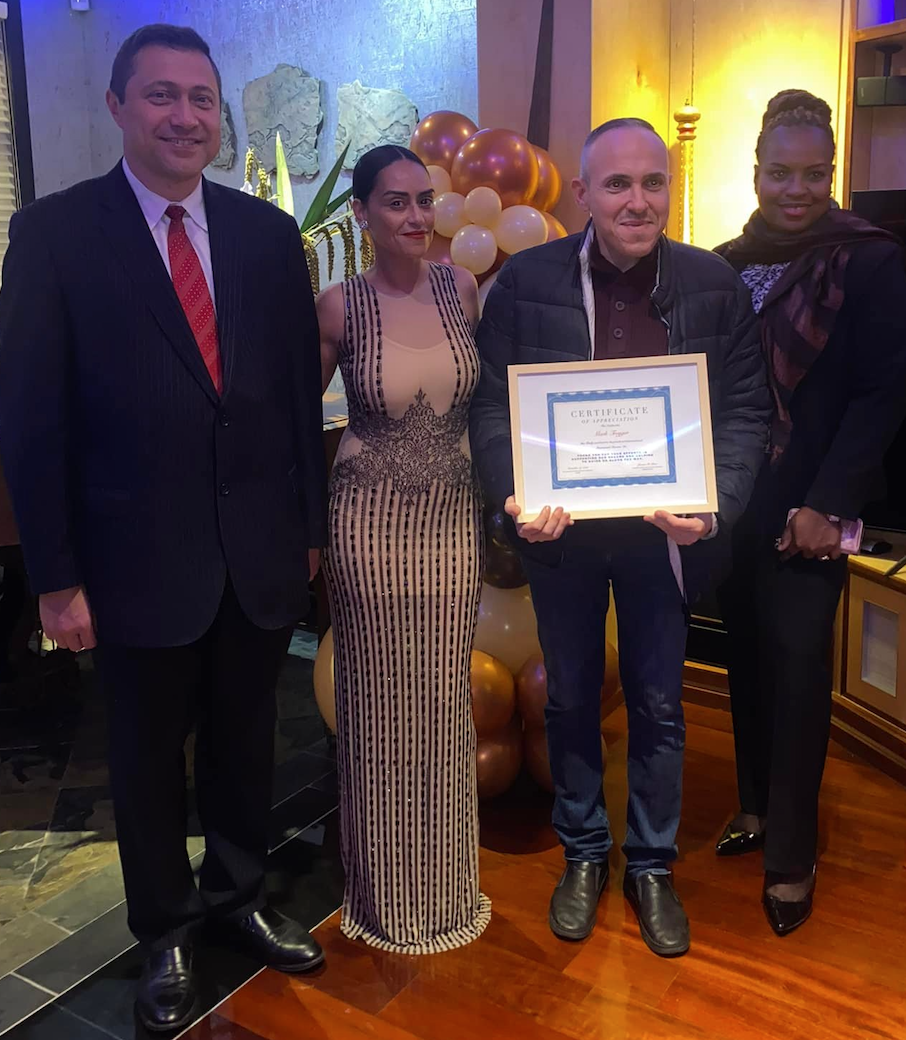
Photo: Courtesy Of Janessa Rose Perez, Janessa Rose Perez (Center) With Elected Officials At The Motivational Monster’s Inc. Gala.
What are your plans for the future with Motivational Monsters Inc. and your book?
I have so many plans. I want to make an audio version of the book and eventually go on a book tour. It’s been well received by my community. What I’m most excited about is developing an interactive creative center, where marginalized people in the community can get help with becoming entrepreneuers or having a creative outlet to build something of their own. I’ve been doing lots of work with the community this year, like launching our summer wellness fair, and our first annual Urban Pumpkin Patch event. I recently held my first Motivational Monsters Inc. Gala to promote my community garden project and get support and funding from elected officials. It’s been neglected for so long and I’d like to turn it into an urban farming community and start a daily urban farmers markets. I was recently asked to join the board as vice president. But, it doesn’t stop there. Fidelis, a big healthcare organization, recently became a sponsor and they are looking to establish wellness programs in women’s shelters and LGBTQ organizations.
It’s clear multi-hyphenate, Janessa Rose Perez shows no signs of slowing down. The entrepreneur and community activist is committed to making the same environment that caused her anguish at times – yet taught her to be resilient – a place where everyone can flourish; an inspirational hub the community can feel happy and hopeful about. As Perez meets and organizes with political leaders to get her projects off the ground, we may see political aspirations of her own in the future. Could she be the next A.O.C.? Putting her community’s needs on the political map and claiming her own moniker: J.R.P. Only time will tell for this inspirational Latina.
To learn about the programs offered by Motivational Monsters, Inc., click here and you can find Janessa Rose Perez’s book on Amazon.
Photo: Ivan Cury, Courtesy of Shoes in the Bed Productions
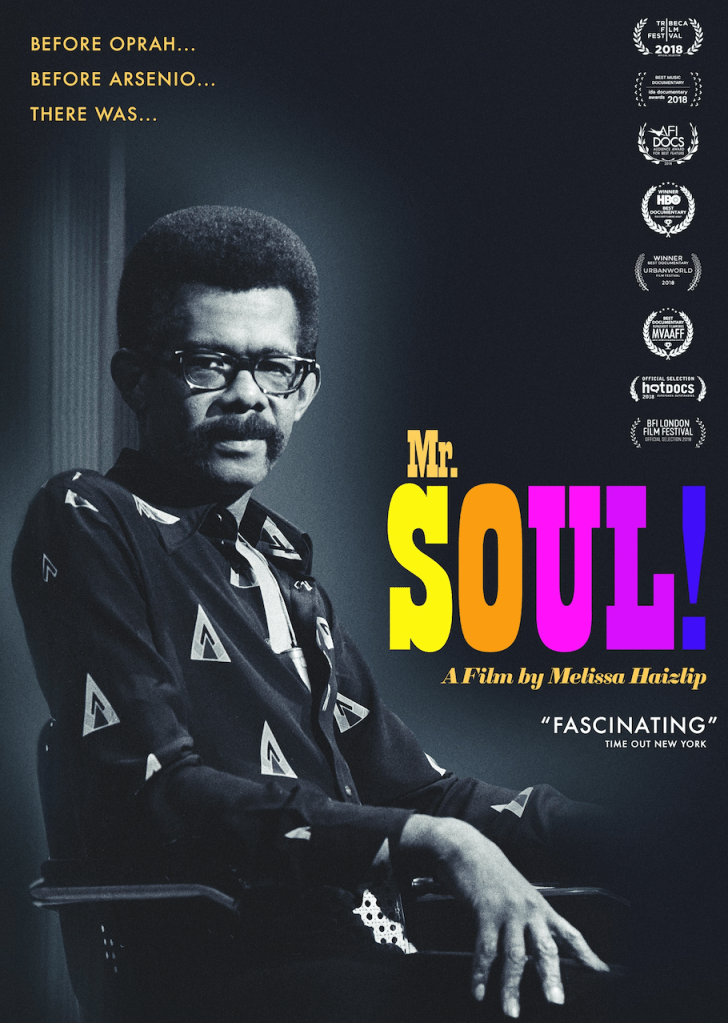
Not long ago, when life had some semblance of normalcy, I had covered the Urbanworld Film Festival in person and was tasked with writing about the festival’s anticipated blockbusters. While waiting for one of these films to begin, I snuck into an adjacent theater to watch the documentary, Mr. Soul! by director and producer, Melissa Haizlip. I was intrigued by the film’s poster; it read: Before Oprah, Before Arsenio…There was: Mr. Soul! As a longtime fan of late-night talk shows, I was irritated and frustrated at myself for not knowing whom this revolutionary pioneer of Black entertainment and culture was. His name: Ellis Haizlip. The producer and host of the PBS variety show: Soul! changed the national scope and existing perceptions of Blacks in a volatile 1960s backdrop – forever! No surprise it won Urbanworld Film Festival’s Best Documentary category and received a standing ovation the Sundance Film Festival. So what was so extraordinary about Ellis Haizlip and this entertainment show he launched in 1968?
Ellis Haizlip Surrounded by Members of the J.C. White Choir, Photo: Alex Harsley, Courtesy of Shoes in the Bed Productions
Ellis Haizlip was a visionary and determined to shatter contrived media perception of Blacks at the time, as victims subjected to abject poverty or lawless citizens in the United States. Raised in Washington in a middle-class family and setting his sights on New York to form his production company, his aim was to push Black Arts forward, as it was evident to Haizlip that there was a huge void to fill. Blair Underwood, executive produced and narrates Ellis Haizlip’s thoughts in the film so eloquently and powerfully states: “Before we can educate and entertain, we need to share the Black experience.” And that Ellis did. In its inception, Soul! aired only in New York and managed to go national in 1969. The once local program set forth the careers of the most prominent artists in Black history: Earth, Wind & Fire, Stevie Wonder and his Wonderlove band, Al Green, Cicely Tyson, Sidney Poitier, and Toni Morrison to name a few. Haizlip was fearless in giving a visual platform to outspoken Black poets like The Last Poets – including 6 female poets, such as Sonia Sanchez, and pushed boundaries by interviewing Minister Louis Farrakhan and Kathleen Cleaver (wife of exiled Black Panther leader, Eldridge Cleaver).
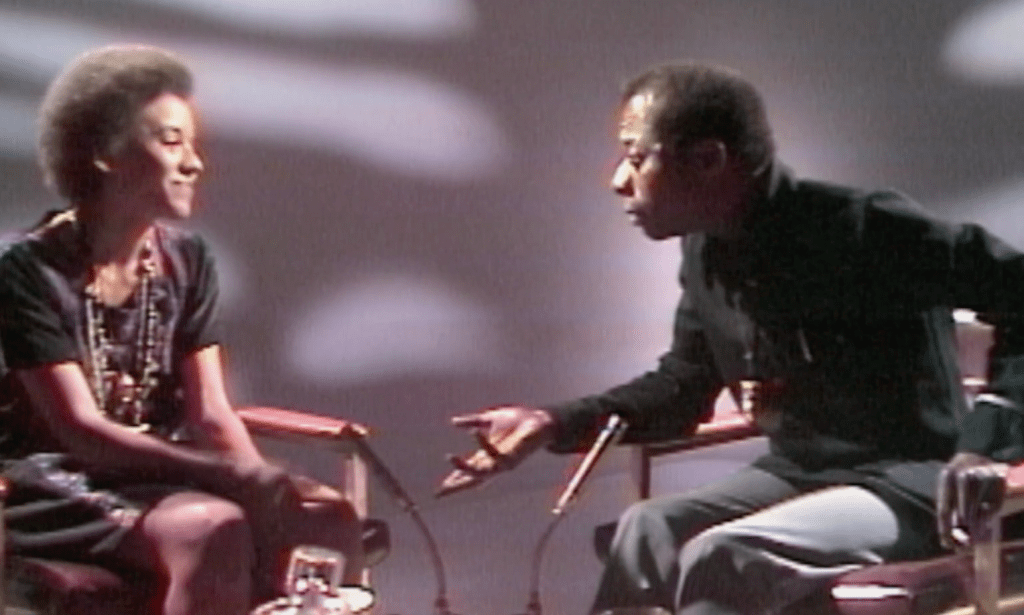
Nikki Giovanni and James Baldwin in 1971, Film Still Courtesy of: Shoes in the Bed Productions.
In his quest to unleash artists’ natural talents via the television medium, he often prompted poets and singers to take the stage unfiltered and unencumbered. He employed females on his set and advocated for an interview conducted by renowned poet and activist, Nikki Giovanni and literary legend, James Baldwin in England. The footage of the animated and captivating Baldwin and inquisitive Giovanni is unprecedented – a Black female interviewer engaging in a fiery conservation with one of America’s beloved writers is quite impressionable to see in 1971, shortly after, Soul! aired until 1973, defunded and shut down by nefarious forces, as detailed in the documentary.
(L to R) – AMANDA SEALES; TOP – MELISSA HAIZLIP/BLAIR UNDERWOOD; MIDDLE – STAN LATHAN/NIKKI GIOVANNI; BOTTOM – SONIA SANCHEZ/ROBERT GLASPER/THE LAST POETS/BLACK IVORY – Courtesy of Shoes in the Bed Productions
So where are we now? It’s 2020 and social justice continues to be a pressing urgent issue in the United States as police brutality continues to plague Black Americans, exacerbated by the tragic loss of our Black icons this year. Mr. Soul’s recent Kickback premiere reminded us of the past, present, and future Black Excellence represents and the need to cultivate and preserve its existence. Host and comedienne, Amanda Seales led the conversation with guests, Melissa Haizlip (Ellis Haizlip’s niece & creative engine behind Mr. Soul!) Actor Blair Underwood, acclaimed director, Stan Lathan (former director of Soul!) Activist and poet Felipe Luciano who guest-hosted the popular “Shades of Soul” episode, featuring Tito Puente and his orchestra, Haizlip exposed television audiences to Latin music and multi-cultural Afro-Latino bands. To say the Soul! television show was groundbreaking doesn’t suffice; it was one of a kind until this day. The legacy Ellis Haizlip left behind cemented the foundation for Black culture never before seen on a national scale – fusing poetry, activism, theatre, dance, and music for the world to experience and solidify the richness of Black arts. Mr. Soul! is available in more than 70 virtual cinemas worldwide through September 10th. To buy tickets and learn more about Mr. Soul! click here.
Jonah Beres as Sam in Balloon, Photo: Courtesy of Film Independent
We are living in unprecedented times. That’s a given. A global pandemic claiming more than 2 million lives and counting, a monumental Black Lives Matter Movement calling for the dismantlement of systemic racism rooted in American foundations. Yet, in the midst of all this chaos (ultimately for the greater good) there is beauty waiting to be discovered through the magical storytelling lens of filmmakers. Stories about communities underrepresented on the screen that need to be seen. This year, Film Independent unveiled 6 short films from their 27th Project Involve program poised to make a lasting impression on audiences. 4 of these films are laced with bittersweet, funny, and controversial themes expressing emotions validating our universal experiences we share as humans.
Balloon, directed by Jeremy Merrifield, and edited by Bowei Yue, follows 14 year-old Sam (Jonah Beres) in the middle of an active-shooter drill, led by the talented Paul Scheer (Officer Hart). Sam, a quiet teen, is the target of harassment after a video of him crying goes viral after being punched by school bully, Jason (Carson Severson). Jason is dead set on seizing any opportunity to get a rise out of Sam and his other victims. Sam’s friend, Adam (Jaylin Ogle), tries to console Sam and urges him to fight back, while not wanting to be labeled as weak by the other boys. When Sam discovers he has super powers to defend himself from his aggressors, he’s at a crossroads: fight back or continue enduring the brutal torments. The film reveals an all too familiar toxic masculinity in American culture and what’s at stake for children and young adults to survive in school. It’s relevant and timely and worth watching.
Lara Cengiz as Kati in Bambirak, Photo Courtesy of Film Independent
The film Bambirak by director Zamarin Wahdat, about an 8 year-old Afghan girl (Kati) and her single father (Faruk), adapting to a new country they’ve sought asylum in is poignant and speaks to the collective solid bond fathers and daughters have. The story begins with Kati (Lara Cengiz) hiding in her dad’s delivery truck. Once he discovers her while making deliveries, Faruck (Kailas Mahadevan) becomes desperate to drop Kati at the grandmother’s home, although she’s nowhere to be found. Faruk enlists Kati to be his assistant. Everything seems to go smoothly until a racist turn-of-events challenge the father-daughter duo. Tensions flare, accusations are made, and with minimal dialogue, the father-daughter team accept the trade-off of being in a new country. Wonderfully acted and scripted, Bambirak is a gem of a short film.
Buck, the narrative short by director Elegance Bratton and co-director Jovan James follows Lynn (Malik Shakur), a young gay black man dealing with his depression in a self-destructive manner that has the potential to lead to tragedy. The film starts off with Lynn’s mother pressing him about his meds. Determined to seek happiness with a visit to his white male lover, Richard (Gabe Peyton), the encounter proves to be disappointing. Lynn realizes there is another gay couple waiting for him to partake in a sexual party. Reluctant and declining to participate, Lynn decides to leave even though he’s taken a hit of Meth, is barely conscious, and is rescued by fellow black gay man whose life is on borrowed time. With the 25 million Americans suffering from depression to date, we don’t see nearly enough films examining and exploring individual experiences with this disease and Buck does a great job of portraying someone who battles mental illness, with empathy, not pity.
Saint from La Gloria film, Photo: Courtesy of Film Independent
La Gloria a film by Mary Evangelista explores the aftermath of an attempted suicide by a young gay Latina (Gloria). And she how copes with lovesickness and sorrow with the help of her grandmother’s optimism and dream-channeling to achieve hope and peace. While the rest of her family glosses over her suicide attempt and go about their everyday lives. Gloria (Chris Gris) and her grandmother’s bond is authentic and compelling. It offers a sweet glimpse into relationships between younger and older generations. And we are here for it!
Film Independent’s 2020 Project Involve Showcase, a carefully curated program of short films spotlighting some of the program’s most exciting new filmmakers. ProjectInvolve (PI for short) fosters the careers of talented filmmakers from communities traditionally underrepresented in the industry, and is celebrating 27 years of working toward a more inclusive entertainment landscape. The program serves as a valuable incubator for diverse talent and has cultivated the careers of more than 820 filmmakers. Notable alumni include Linda Yvette Chavez & Marvin Lemus (Gentefied); Jon M. Chu (Crazy Rich Asians); Jomo Fray (Selah and the Spades); LaToya Morgan (Into the Badlands); Justin Simien (Dear White People); Lulu Wang (The Farewell), Kim Yutani (Director of Programming, Sundance) and many more. To learn more about Film Independent and Project Involve, click here.

















 Don't Suck My Collagen